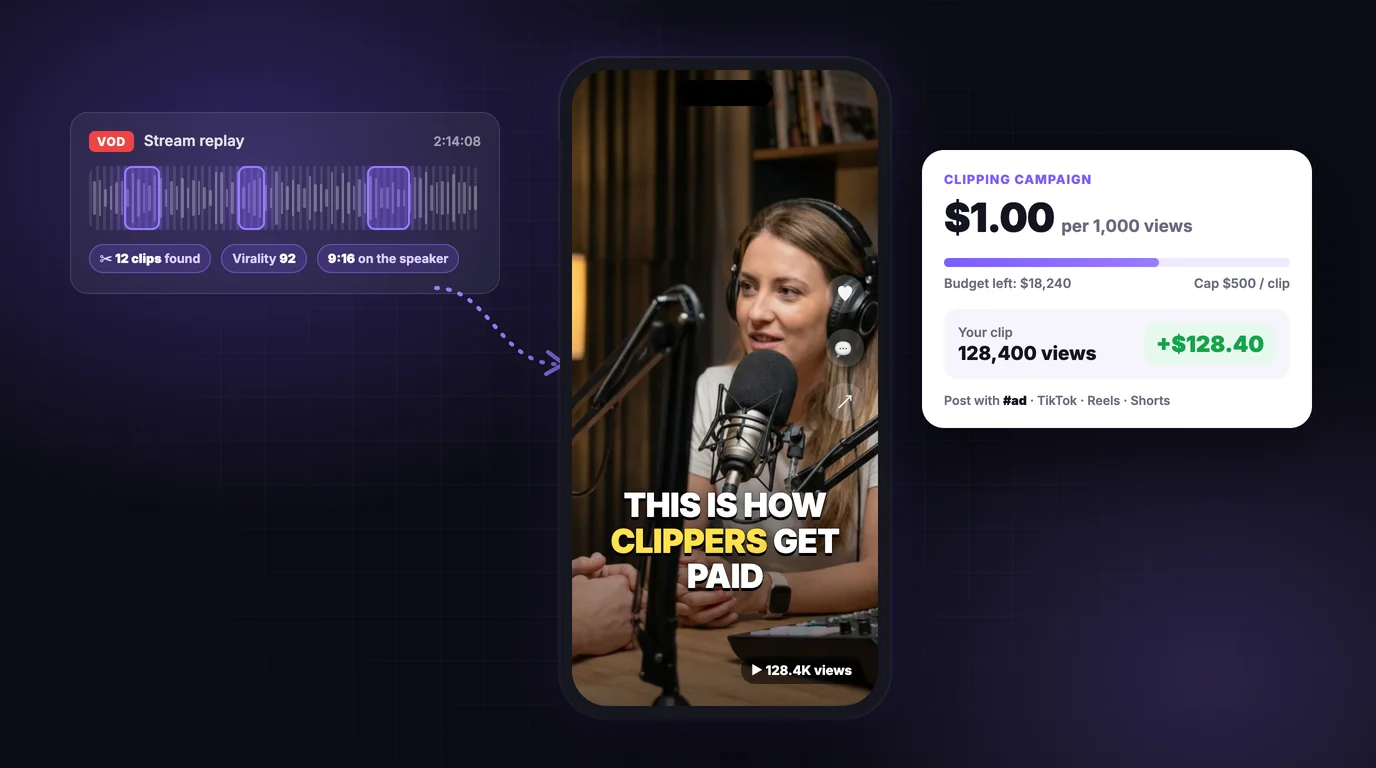
Clippers get paid per view to turn streams, podcasts and interviews into short clips. How campaigns work, what they really pay, the rules that get clips rejected, and a workflow to post more clips a day.
StoryCut Team
October 11, 2026
What Is Clipping?
Clipping is cutting short clips out of long videos (a livestream, a podcast, an interview, a talk) and posting them on TikTok, Instagram Reels, YouTube Shorts or X. The people who do it are called clippers.
Creators and brands pay for it because every clip is free distribution: a two-hour stream reaches the people who watched it live, while thirty good clips reach people scrolling short-form feeds all week. In 2026 that turned into a market. NPR reported campaigns from Polymarket, Major League Baseball and AI startups, and one startup that worked with more than 700 clippers. Streamers run their own programs too: Tubefilter reported that the streamer N3on paid $1.4 million to 303 clippers in five weeks.
You don’t need followers to start. Most campaigns pay on the views your clips get on your own accounts, so a new account with a good clip can earn from its first post.
How Clippers Get Paid
Almost every campaign pays the same way: a rate per 1,000 views. • The brand or creator funds a budget and sets the rate, for example $1 per 1,000 views. • You post a clip on your own TikTok, Reels, Shorts or X account, following the campaign’s rules (which content, which tag, which countries). • You submit the link. The platform checks the views and pays you, usually with a minimum view count before a clip pays and a maximum per clip. • The budget runs out when the campaign has paid for the views it bought. Early clips have the best chance, which is why speed matters.
Platforms such as Whop’s Content Rewards list hundreds of campaigns, and keep a fee on payouts. Some streamers and agencies skip the platforms and pay their clippers directly through Discord programs.
What Clipping Campaigns Pay
Rates and terms of real campaigns, from public reports and listings. Most pay between $0.50 and $2 per 1,000 views.
Checked on October 11, 2026. Campaigns end when their budget runs out.
Campaign
Rate
Terms
Polymarket (NPR)
$0.50 per 1,000 views
From a $70,000 budget
Major League Baseball (NPR)
$1 per 1,000 views
Highlights from MLB content
An AI startup (NPR)
$25 per 1,000 views
An outlier: most campaigns pay far less
N3on’s clipping program (Tubefilter)
About $40–50 per 100,000 views
$1.4M paid to 303 clippers in five weeks
An AI video brand on Content Rewards
$2 per 1,000 views
$1 minimum and $500 maximum per clip; Instagram only; part of the audience must be in the US or similar countries
Do the math before you start. At $1 per 1,000 views, a clip with 100,000 views earns $100, and one with 1 million views earns $1,000 if the campaign’s cap allows it. Most clips get far fewer views: a few hundred or a few thousand. Clippers who earn steady money post many clips a day across several accounts, and a handful of their clips carry the month.
NPR met clippers who made $2,500 in two weeks and $4,000 in a month, and many more who made little. There is no guaranteed income: what you earn depends on the views your clips get, the campaigns you join and how fast you post.
The lever you control is volume at a good level of quality. If finding and editing one clip takes you 30 minutes, you post 10 a day at most. If a tool finds the moments and does the edit, you can post several times that from the same hours.
Where to Find Clipping Campaigns
• Content Rewards on Whop lists campaigns from brands, apps and creators, with the rate, the budget left and the rules of each one. • Creators’ own programs. Streamers and podcasters post clipping programs on their Discord servers, often with a channel for submissions and a leaderboard. • Clipping agencies hire clippers for several creators at once and pay per view or per clip. • YouTube and TikTok are full of clippers explaining which campaigns pay best right now. Check the date: campaigns end when their budget runs out.
Read every campaign’s rules before you clip. Most say which videos you may use, the clip length, the platforms, the tag to add and the countries your audience must be in.
The Rules That Get Clips Rejected
• Disclosure. A paid clip is an ad. Add #ad or the campaign’s tag, and turn on the platform’s paid-promotion label: YouTube has a checkbox for it, and TikTok has a branded-content toggle. • Real views only. Campaigns check views and claw back payouts for bot traffic, and buying fake engagement is illegal in the US under the FTC’s rule on fake reviews and social indicators. • Permission. Only clip content a campaign or creator lets you clip. Clipping someone else’s videos without permission gets clips removed for copyright, and accounts with repeated strikes get banned. • Reused content. YouTube’s rules exclude re-uploads and repetitive, mass-produced videos from monetization, and in October 2026 YouTube said re-uploads without significant changes get less distribution in Shorts. Clips with your own edits, such as captions, a hook, zooms and a tight cut, are on the safer side.
A Clipping Workflow That Scales
1
Pick the source
Take the newest video the campaign allows: a stream VOD, a podcast episode or an interview. New content has the most search and the least competition from other clippers.
2
Let AI find the moments
Paste the YouTube link in StoryCut’s AI clips, or upload the VOD (2 to 150 minutes). In about 5 minutes per hour of video you get 3 to 12 vertical clips with captions, sorted by a virality score.
3
Make each clip yours
Keep the strongest clips. Add a hook title for the first second, change the caption style, add a zoom on the punchline or a sound effect. These edits are what make a clip yours.
4
Post with the tag, then track
Export the MP4, post it with the campaign’s tag and paid-promotion label, submit the link, and note which clips got views. Do more of what worked.
What Makes a Clip Get Views
• The first second. Start on the line that makes people stay: a claim, a question, a reaction. A hook generator helps when the moment needs a title on screen. • One complete thought. A clip that ends mid-sentence loses people. Clips between 20 and 60 seconds with a clear start and end do best for most clippers. • Captions on every word. Most people scroll with the sound off. Big, animated captions keep them reading. See our AI captions and the Hormozi-style presets. • Vertical, on the speaker. A 9:16 crop that follows whoever talks looks native in the feed. • A title and hashtags that match. On Shorts, a clear title and a few relevant hashtags help the right people find the clip. • Consistency. Post every day in the same style, so viewers who like one clip recognize the next.
Which Tools Do Clippers Use?
Clippers use an AI clipping tool to find and cut the moments, then a caption and editing tool, or one tool that does both. The common ones are Opus Clip, Vizard, Submagic, Klap and CapCut.
StoryCut does the whole job in the browser: AI clips finds and reframes the moments, every clip gets animated captions, and the editor adds hook titles, magic zoom, sound effects and music. It works from a YouTube link or a file you upload, so Twitch and Kick VODs work once downloaded. See StoryCut for clippers and how it compares with Opus Clip.
Frequently Asked Questions
Yes. Brands, apps and streamers pay real money for clips through platforms such as Content Rewards on Whop and their own programs. It pays per view, so income depends on how many views your clips get. Be wary of anyone who sells a course promising a fixed amount.
No. Campaigns pay on the views each clip gets, and short-form feeds show clips from new accounts to new people. Followers help, but a good clip on a new account can earn from its first post.
Most campaigns pay about $0.50 to $2 per 1,000 views, with a minimum view count and a maximum per clip. A few pay more: NPR reported one at $25 per 1,000 views.
Yes. StoryCut runs in a phone browser: paste a YouTube link in AI clips, pick the clips you want, then download each MP4 to your phone and post it.
Clipping with the creator’s permission is allowed. To be monetized and reach people in Shorts, clips need real changes: YouTube excludes plain re-uploads from monetization and gives them less reach since October 2026.
Yes. A clip you are paid to post is an ad: add #ad or the campaign’s tag, and turn on the platform’s paid-promotion or branded-content label.
The one that gets you from a long video to finished clips fastest. StoryCut finds 3 to 12 clips in about 5 minutes per hour of video, reframes them and captions them, with hook titles, zooms and sound effects one click away. It has a free plan with 1 long video a month.
Turn Your Next Stream Into Clips
Paste a YouTube link or upload a VOD and get up to 12 captioned, vertical clips in minutes. 1 long video a month free, no credit card.